

 Jodie Weston
This site contains affiliate links. As an Amazon Associate, I earn a commission from qualifying purchases at no extra cost to you. Full Disclosure Here.
Editor’s Note: This is an updated and revised edition for 2018.
I love my cast iron skillet. Even though I have had it for just a few years, it is the most used piece of cookware in my home. Perhaps it is nostalgia for what I perceive to be the good old days – think Pa and the boys cooking up some chow on Bonanza – or simply a longing to, in some small way, shun our spit-shined, high tech society.
Whatever the case, I am now really “in” to cast iron.
Last month I needed to take my beloved 12” skillet down to bare metal and and re-season it anew. This made me think that perhaps it was time to share some cast iron tips with Backdoor Survival readers. After all, we all need a first-time intro at some point or refresher from time to time!
If you were lucky enough to get some cast iron cookware as a gift, you probably have some anxiety about using it. And even if your are a cast iron diva – well experienced in its glories – you may have some questions about it’s use and care for the long term. Today I offer some cast iron tips and suggestions that will guarantee your cooking adventures with cast iron succeed.
1. Seasoning is your friend
Cast iron needs to be seasoned in order to acquire non-stick capabilities. An unseasoned piece is a disaster waiting to happen. You food will taste like, well, rusty iron. Food will stick like crazy. And clean-up? Forget it.
 These days, if you are starting new, you can purchase a pre-seasoned pan. That is what I did. Lodge as well as other manufacturers sell pre-seasoned pans for just a few dollars more than the unseasoned kind.
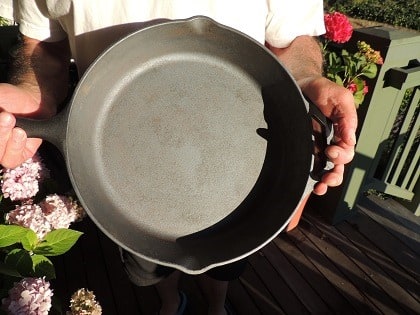
But not to worry if you acquired an old rusted out or unseasoned pan from a friend, relative or thrift store, you can find my instructions for seasoning a cast iron pan from scratch right here in the section below. (See pictures of some old, rusted cast iron skillets to the right. These are completely salvageable.)
The key to obtaining a slick, well blackened cast iron pan is to continually re-season. You do this by wiping a thin layer of vegetable oil along the inside after each use. (I use this little mop thingy. I purchased). I am still doing this to my skillet and it is getting nice and dark. I am sure that the time will come when I can give this up but for now, I like how nice and shiny the pan is getting.
Seasoning a new (or old unseasoned) pan
When you first get your pans whether new or second-hand, the first thing you should do is season them. To do this:
- Preheat the oven to 325°F.
- Wash your pan with a mild dish soap and a stiff brush to remove old food particles and loose rust that may have accumulated. (It is okay to use soap this time because you are preparing to re-season the cookware).

- Rinse and dry completely.
- Using a clean rag, apply vegetable oil to both the inside and outside of the pan. You can use lard or melted shortening instead of vegetable oil if you like.
- Place the pan upside down on the oven’s center rack.

- Place a sheet of aluminum foil below the rack to catch any drips. I like to use a foil-covered cookie sheet for this.
- Bake for one hour.
- Turn off the oven and allow the pan to cool completely before removing it from the oven.
- Store the cookware uncovered, in a dry place when cooled.


2. Cook with a bit of oil
Or use cooking spray if that is something you use. Just like coating the pan with a thin layer of oil after each use, while the pan is new you should cook with a bit of oil. Of course you would not do this while frying bacon and, as a matter of fact, cooking foods with a lot of fat in them will simply accelerate the long term seasoning process.
Keep using that bit of oil while cooking until your pan has a dark, satiny patina. Then be brave and try cooking without. If you find you now have a non-stick pan, great! You can add extra oil only if you wish to add some flavor.
3. Preheat the pan
 Cast iron heats evenly; no hot spots or cold spots on this puppy. To take advantage of this even heat, preheat first. Be sure to let you cast iron heat up gradually as the burner or oven heats up since a cold pan on a fiery hot burner could break or crack from thermal shock.
And remember, that pot or pan will be very hot. Use mitts (or Ove Gloves) for protection.
4. Store cooked foods somewhere else
The acid in foods will break down the seasoning in your pan and impart a metallic taste. When the meal is over, take the time to store your food in a suitable container.
5. Never every use soap for cleaning, and dry thoroughly

Soap will destroy that wonderful, non-stick patina. Don’t do it. Instead, scrape off the bits of food left in the pan and if necessary, use some salt and a tad of water as a scrubbing agent.
Whatever you do, do not allow your cast iron cookware to air dry. It will rust. Instead, dry it well and for good measure add that coat of oil we talked about in #1 above.
I used to have a scrubbing sponge that I used exclusively on my cast iron. When done cleaning, I would store it away in a Ziploc baggie so I did not mix it up with the day to day soapy sponge. Six months ago however, on a lark, I ordered this chain-like gizmo called “The Ringer.
The purchase was based upon one of those “just for you” suggestions and in a moment of weakness, I fell for it. Little did I know that cleaning my cast iron skillets would become so easy. Not that cleaning cast iron is difficult, mind you, but it can and does take some time.
Pre Ringer, I would add a bit of water and salt to the dirty skillet and scrub. If the pan was especially grungy, I would set it on the burner and bring the water to boil first. This, in itself, is an effective way to loosen those crusty bits of food from the bottom of a cast iron skillet or pan.
With the Ringer, I skip both the boiling water and the salt. Here are some photos so you can follow along.

A crusty, dirty cast iron skillet. BTW, the burgers were delicious.

This is what the Ringer looks like in use.
For really big messes, you can also add water to pan before scrubbing caked on food residue.

My skillets have never looked so good. Not only that, I am not seeing any rust spots develop (it happens) and can only assume that the Ringer scrubs them away. Before storing the pan, I give it a very light coating of coconut oil and I am done. That’s it. Start to finish, two to three minutes and no elbow grease.
In order to build up to that nice non-stick finish, re-season your pan every time you wash. To do this, after you rinse your pan, heat it on high on the stove top. When the water has evaporated, add about a half of teaspoon of cooking oil and rub it around with a cloth, being careful not to burn yourself. Continue heating the pan until it begins to smoke, then rub just a bit more oil on it. Turn off the stove and let the pan cool completely.
Every time you use your cast iron with cooking oil, it adds to that non-stick finish. So the more you use it, the better your pan will cook. Cooking very acidic food, like tomato, lemon juice or vinegar, can wear down this finish.
If the surface starts to look dull and the food begins to stick to the pan, re-season it in the oven again. If your cast iron is not well-seasoned, things like eggs and fish may stick to the bottom.
6. Quality counts
The best quality pan is a pan that has been passed down from Grandma with a 50 year history of use and seasoning. Alas, not all of us can be that lucky. For the rest of us, a good quality pan will more than pay for itself. Look for a fine grain on the surface without a lot of pitting.
Equally important, make sure the cast iron has a uniform thickness and that it sits level on flat surface. No wobbles, please. (See the recommendation section below for my recommendations on the best cast iron cookwear!)
7. Have a blast!
Sure you may have some fancy, department store cookware in your cupboard. I do. And I must admit, it does a great job. But there is something rewarding in pulling out a pan that is steeped in tradition and history even if it is brand new.
Experiment cooking with your cast iron. Try oven frying and baking and whatever you do, use it often. Have fun.
Special Considerations for Cast Iron Cookware
Cooking with cast iron may take some getting used to! It’s comparable to switching from an electric range to a gas range. Cooking times and temperatures are slightly different. I burned the beans several times before getting it right.
Your cast iron cookware will retain heat longer. Therefore, use a hot pad and trivet to prevent burns, both on your skin and on the surface the pan is set on. A handy dandy cloth hot handle holder and a lid lifter are fabulous additions to your cookware set.
Although theoretically, cast iron will not become scratched up from metal utensils, my family is pretty hard on pans, so I’ve invested in some wooden utensils to use when cooking.
Cast iron is heavy. I’ve discovered that it is much easier to serve from the stove onto plates rather than carry the skillet to the table.
Cast iron is inexpensive and, with nominal care, practically indestructible. It can be safely used indoors or out, over gas, electricity or a campfire. With two or three pieces, you can cook almost anything.
What is not to like? As you think about outfitting yourself with gear, consider versatile cast iron.
One thing is for sure: it will not make you sick from toxic fumes or coatings that come off during the cooking process. And for that reason alone it is highly recommended.
I experienced a lot of trial and error as I learned to cook with cast iron. Probably the most important thing I learned was to wear gloves when handling the hot skillet or pot and also be make sure that the piece was completely dry before putting it aside for next time.
Final Word on Cooking with Cast Iron
There you have it, irrefutable proof that cast iron cookware is a must-have in your Prepper kitchen. I know I’m glad I made the switch. How about you?
Do you have any favorite recipes to share?
Keep reading, or see the sections below to learn my recommendations for the best cast iron skillet and other cookware, as well as how to cook some of my favorite foods using cast iron!
~~~~~~
My Recommendations (Skillets and other Types of Cast Iron Cookware)
Survival Woman Reviews her new Lodge 12 inch Cast Iron Skillet
 About six weeks ago I starting thinking about how I would cook over an open fire. One thing I knew for sure: I was not going to practice high heat, open fire survival cooking using my prized Analon non-stick cookware. No way.
So I brought in the old, woefully unused 10” skillet from the garage and used it to fry up a few burgers using the highest flame possible on my gas range. Yum, these were pretty tasty. Next I tried sautéing some veggies. Those were tasty too. But alas, this little skillet was only good for a single serving – or two pygmy servings in our household. Time to get a larger skillet I said to myself.
Circling back to the beginning of this post, I did a bit of research and ordered the Lodge 12 inch skillet which was pre-seasoned (Yay!). Not only that. it was within my under $30 budget. Compared to my Analon (non stick) skillet, this was a steal.
Now that I have used my new skillet, I can honestly say that this is one tool that will become a mainstay in my kitchen. I simply love this pan. So far I have used it for hamburger steaks, (a Survival Husband specialty), for stir fries, and for my very own survival stew (brown rice, garbanzo beans, canned tomatoes, onion, and a bit of chili powder).


Reasons to Love this Pan:
- This skillet gets hot, really hot and retains the heat even after turning down the burner.
- Adding food to a hot pan does not cool it down – not even a little bit. That means fried food continues to fry rather than steam.
- It appears indestructible. It’s made if solid iron, for goodness sake.
- Food does not stick. I have been using a smidgen (less than a teaspoon) of canola oil on the pan. I rub it around with this mop thingy (actually, a basting brush) and so far so good. It is my understanding that after a few months of use, I can forego the oil.
- Food cooks evenly. I mean it. The iron is so thick and is such a good conductor that heat distributes perfectly across the pan with no hot or cool spots.
- There is an “assist handle” on the opposite end of the main handle. If you’re like me, lifting up a hot, eight pound pan laden with food is not exactly easy. The ability to grasp both sides of the pan is a bonus.
- It is made in the US.
Now to be honest, there are a few negatives to this pan:
- It is very heavy, weighing in at 8 pounds.
 Add a bunch of food and this is one heavy pan.
 - The handle gets hot. which could be a problem if you are not prepared. Me? I swear by my Ove Gloves and use them whenever I cook. The scars on my arms will attest to the number of burns I have from careless cooking these last two years. I purchased the Ove Gloves last summer and never looked back.
- If not cleaned properly, cast iron will rust. This has not been a problem so far.
Cleaning
Because ordinary cookware cleaning techniques like scouring or washing in a dishwasher can remove or damage the seasoning on a bare cast iron pan, these pans should not be cleaned like most other cookware. Some cast iron aficionados advocate never cleaning cast iron pans at all, simply wiping them out after use, or washing them with hot water and a stiff brush. Others advocate washing with mild soap and water, and then re-applying a thin layer of fat or oil.
A third approach, advocated by television chef Alton Brown, is to scrub with a bit of coast salt a paper towel or clean rag. I like this idea since the salt gives a little boost to my elbow grease (see full cleaning instructions for cast iron earlier in this article).
About Lodge
According to the Lodge Manufacturing website:
When Joseph Lodge began making cast iron in 1896, he began a legacy that would create the foundation to an enduring standard of quality carried forward by four generations of family management. The resulting privately held metal formula, precision molds and exacting mold wall thickness are the result of years of dedication to improving quality that began with the first skillet from the first sand mold.
Not even the most expensive stainless and aluminum cookware can rival the even heating, heat retention, durability and value of Lodge Cast Iron. Its legendary cooking performance keeps it on the list of kitchen essentials for great chefs and home kitchens alike.
For more than four generations Lodge has been making cast iron cookware. And, much of the cookware made generations ago is still in the kitchens of fourth generation cooks. That’s why we say that when you choose Lodge Cast Iron Cookware, you’ve made a friend that will last more than a lifetime. The Lodge family appreciates your patronage and hopes that if this is your first piece of Lodge Cast Iron, it will be the first of many.
Lodge 12 inch Cast Iron Summary
Although I am still learning, I already love my Lodge cast iron skillet. It appears to be the perfect size, especially when you consider that the weight of anything larger would be too heavy for me to handle. Given its ability to withstand high temperatures and hold the heat, it will be perfect if we ever need to cook outside on our fire pit or over a campfire.
My only concern, to be honest, is that once I try making cornbread in my new skillet, I will have to go on a diet because the results will be so good!
Other Types of Cast Iron Cookware
There are a variety of different types of cast iron cookware, suitable for nearly all types of cooking. Here’s a short description of each type. Make sure you purchase those that best suit your cooking style and preferred recipes.
- Waffle Irons: This essential tool will make that distinctively gridded breakfast delight. Electric cast iron models are available, but for Prepper purposes, I recommend the old fashion ones with long wooden handles. These beauties can cook waffles either on the stove top or over the open flame.
- Panini Press: This cookware can be found with long handles similar to the waffle iron or as a squarish skillet-like pan with ridges that has a smaller lid also with ridges used to press the food flat as it cooks. It works great for bacon, grilled sandwiches, meat, and vegetables.
- Crepe Makers: This pan is round and has no or a very small edge. This isn’t a pan you can prepare soup in. Crepes, eggs, pancakes, quesadillas, pizza, and hamburgers all can be made using a crepe maker.
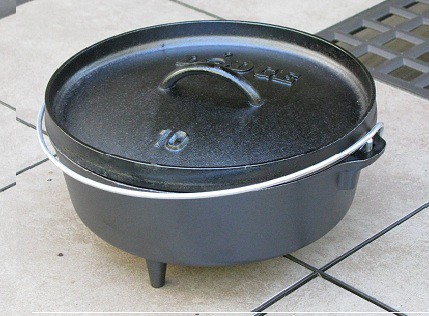
- Dutch Ovens: In some areas, this pot is called a casserole dish and can be found with or without legs. Dutch ovens range in size from 2 ½ quart capacity, which will hold up to 3 pounds of meat, to a whopping 20 ½ quart capacity, that will hold about 20 pounds of meat.
In addition, dutch ovens can be used as roasting pans or soup pots. They also work great for frying and bread baking.
- Oval Roasters: These are primarily designed for use in the oven and are oval, as the name implies. They are available in 4 sizes ranging from 4 to 20-quart capacity. Think roast and bread for this one!
- Skillets: Cast iron skillets also come in a variety of sizes, from a 6-inch diameter with sides 1 ¼ inch high to a 19 ¾ diameter with a side depth of 2 ½. You can find skillets that are round or square. Some have one long handle, others have two smaller handles.
Personally, I recommend a round skillet somewhere between 9-10 inches in diameter with a 2-inch depth and a long handle for stove top use. It’s a good size for cooking, frying, and baking a variety of dishes.
- Branding skillets: These are skillets or grill pans, either round or square, which have grilling ridges on the bottom and are useful for searing meat and grilling vegetables.
- Frying pans: These are essentially deeper skillets with a depth averaging about 3 inches. Dutch ovens are just as good for frying as frying pans and are more versatile. Really, the only difference between a Dutch Oven and a frying pan is the long handle on the frying pan.
 Griddles: This is a two-burner pan and is oval or rectangular in shape. It may be completely flat or have a small lip to keep grease from going over the edge. The griddle in my home is reversible. One side is flat and suitable for pancakes, eggs, sausage, and quesadillas. The other side has ridges and is great for grilling meat. We use this pan every day!
- Tea Kettles: Be careful when purchasing a new cast iron tea kettle. Many newer models are glazed with enamel inside which would be damaged if you use your tea kettle to boil water. Find one without the enamel glazing. Cast iron tea kettles typically come with a tea strainer that fits under the lid for proper tea brewing.
- Woks: Regular cast iron pans won’t work well for stir fry. So, if you love stir-fried meals, it is better to invest in a cast iron wok. If you can get a wok made in China, you will find it differs little from a steel wok in size and weight.
 Griddles: This is a two-burner pan and is oval or rectangular in shape. It may be completely flat or have a small lip to keep grease from going over the edge. The griddle in my home is reversible. One side is flat and suitable for pancakes, eggs, sausage, and quesadillas. The other side has ridges and is great for grilling meat. We use this pan every day!
Woks made in other countries are thicker, take longer to heat and are more difficult to work with overall.
~~~~~~
Favorite Cast Iron Foods
 There is no question that I have a love affair with my (now) four cast iron pieces: my Lodge Logic Pre-Seasoned 15 Inch Cast-Iron Skillet. (also called a camp stove) and a smaller, 10” skillet. So what are my favorite uses for cast iron? Just for fun I will list them for you:
- Hamburger patties: Fried in a bit of Worcestershire sauce they are perfect. The splatter does make a mess. Try this outdoors on your rocket stove.
- Fried potatoes: Don’t knock it until you have tried it. I cut the spuds into wedges and toss them in about a tablespoon of oil. After preheating the skillet in a 450 degree over, in go the potatoes. These are sooooo good.
- Biscuits: I cheat and use a mix Fisher’s. I drop them in the skillet (indoors) or Dutch over (outdoors) and bake. Great with soup.
- Salmon fillet: Yep, even the salmon goes into the oven on my cast iron skillet. I add a bit of butter, garlic and basil if it is in season.
- Pineapple Upside Down Cake: Wishful thinking since I actually have not made this myself but I have had it at a friends house. To die for.
But nothing beats the king of meats, the classic Steak.
Cooking Steak on Your Cast Iron Survival Skillet
 If you think grilling your meat is the way to go, I would like to challenge you to try something new. Grab that survival skillet – cast iron, of course – and prepare steak like you have never experienced!
Step by step, here is how you do it.
1. Put your cast iron skillet in the oven and pre-heat to 500 degrees. You are going to want to get that baby really really hot. Get out those oven mitts, or, better yet, those Ove gloves. I told you about awhile back.
2. Grab your piece of meat and pre-season with a marinade or with a paste made out of olive oil, kosher salt and a little pepper. Here is my favorite marinade in case you are interested.
Mix together 1 tablespoon each olive oil and soy sauce. Put your steak in a dish and coat each side by turning it over a couple of times. Sprinkle generously with Montreal Steak seasoning.
Extra credit: Throw it all in to your FoodSaver Marinator and let it rest for 30 minutes or so while you are getting the rest of your dinner together. Here is what the marinator looks like loaded up and ready to go.
4. When the oven is up to temperature, take the skillet out of oven (with your Ove Gloves or other protective device) and put it on the stove. The burner should be set for as high as it will go. At this point it would be a good idea to turn on the fan vent in your kitchen unless you like to hear the sound of smoke alarms going off.

5. Take your steak and put it in the hot skillet. It should start to sizzle real nice. Now the hard part. Time this one side for 30 seconds – 40 max – then flip it over and do the other side, The steak should be nice and brown and crusty on both sides.
6. Now it is time to transfer the whole shebang back into that 500 degree oven. Close the door and set your timer for two minutes. Flip and cook for another two minutes. If you started out with a nice, 1” steak, it should be close to medium rare. I cheat and use one of these instant meat thermometers just to be sure.
7. You are not done yet. Take the steak out of the pan and place in on an upside down plate so it is a bit elevated. This is so it does not sit in its juices. Cover with a tent of foil and let it rest (poor thing) for 2 to 5 minutes.
 Done all that? You are now ready to eat the most delicious steak you have ever tasted. I think it has something to do with the high heat and hot skillet, Since using this method, we have not had a single, dried out piece of meat. Now try that will you BBQ grill!
Your skillet is multi-tasking. One other thing. Your skillet is as heavy as a brick. Actually, as heavy as a bag of bricks. Get used to hefting it and when the next zombie attack occurs, you can swing your skillet to defend yourself. The heck with the baseball bat.
~~~~~~
Cast Iron Recap: Why Choose Cast Iron In the First Place?
1. Long-lasting
Generations of women have been using cast iron cookware primarily because of its durability. Cast iron will last for decades if properly maintained. So even after all the stores close and zombies are running amok in the streets, your cast iron will still be going strong.
2. Healthier
What you cook with can either detract or add to your food’s overall nutritional value.
Non-stick pans leech plastic polytetrafluoroethylene toxins into the air when heated which can cause potentially fatal polymer fume fever and are a contributing factor to increased perfluorinated carboxylic acid found in breast milk of women using this type of cookware.
On the other hand, cooking with cast iron cookware aids in the development of trans fatty acids in the cooking oil which might give someone pause.
3. Versatile
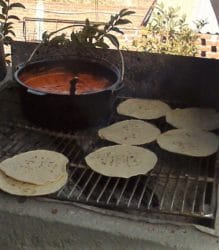 Cast iron pans can be used on the stove, in the oven, and over the campfire. There is a pan perfect for every recipe. Furthermore, cast iron pans are heavy and may be just the thing you need to thwak that unwanted intruder in the noggin when worse comes to worst.
Now that we understand cast iron is the way to go, let’s talk about which pans you should have in your Prepper kitchen.
Why Choose to Cook with Cast Iron Cookwear?
- Cast iron can be used both indoors on a traditional stove or outdoors over an open fire, rocket stove or gas grill.
- It conducts heat and gets really, really hot. And then it holds that heat for a long time which is important if you must conserve fuel.
- A well seasoned (meaning well-used) cast iron skillet is extremely non-stick.
- Any old utensil or spatula can be used without harming the surface. Shoot – you can even stir food around with a tree branch or twig without harming the surface.
- Foods browns quickly. And browned food = flavorful food.

- Cast iron is practically indestructible. There are no rivets, screws, or welded points that can fail. That makes it so durable that with proper care, it can be used for decades if not centuries.
- It is healthy. A tiny bit of iron will leach from the skillet into your food. I am talking about a teensy tiny few milligrams which, in a survival situation, will be especially vital to your good health.
It Can’t All be Good Can It?
OK, truth be told, there are a few negative aspects to a cast iron skillet.
- At 8 pounds, it is downright heavy and the handle gets extremely hot – burnable hot. You must be careful. I swear by my Ove Gloves and use them whenever I cook. A less expensive alternative are welding gloves that can be purchased for a very modest price either.
- After cooking in it, you need to scrape out the leftover bits of food and rinse it out (without soap if you are a purist like me) and dry it really well so that it does not rust. A little coating of oil does not hurt either.
- You also need to be careful that you do not remove your cast iron skillet from the heat source and plunge it under a stream of cold water. Doing so may cause it to crack or to shatter. Not pretty.
- If not cleaned and dried properly, cast iron will rust.
For some, the cast iron skillet may be an ugly duckling. But I think the humble cast iron skillet is gorgeous!
Experiment cooking with your cast iron. Try oven frying and baking as well as pan frying. Whatever you do, use you cast iron skillet often. I guarantee that you will be hooked and will want to start adding to your cast iron cookware collection, one skillet and one Dutch oven at a time.
Enjoy your next adventure through common sense and thoughtful preparation!
Gaye
From the Bargain Bin:
Below are some of my favorite cast iron items including some useful accessories:
Lodge Logic 12-Inch Pre-Seasoned Skillet: This purchase changed the way I cook. I use my cast iron cookware for everything from salmon, to bacon and eggs, to biscuits. Don’t forget the Lodge Set of 2 Pan Scrapers, a must have for cleaning those food bits from your cast iron cookware.
Lodge Dutch Oven/Camp Stove: I originally purchased this Dutch oven because it was so darn cute. But over time, I have learned to love it for its versatility. Remember, a camp stove is designed so that you can bake with it by arranging charcoal on top of the lid as well as underneath the Dutch Oven itself.
‘Ove’ Gloves Hot Surface Handler: I cannot say enough about these hand and arm protectors. I have permanent scars from hitting my arm on the rack of my oven. I can only imagine what I would look like if I did not use these with my cast iron cookware. Forget the colorful silicon hot pads. These are 1000 times better!
Four Silicone Brushes: I call these”mop thingies”. Great for layering a nice thin coat of oil on your cast iron pans.
Lodge 5-Quart Double Dutch Oven and Casserole with Skillet Cover: This is another cool piece. This Dutch Oven does not have legs and is designed for indoor use – but it can be used outdoors too. Just don’t forget the Ove Gloves.
Lodge Logic Pre-Seasoned 15 Inch Cast-Iron Skillet: Similar to the 12” skillet only bigger. Actually, quite huge (and yes, I finally have one!).
US Forge 400 Welding Gloves Lined Leather: These well-priced gloves provide complete heat and burn protection. They are made of soft and supple top grain leather for comfort and pliability, plus they have an internal liner gives more comfort and durability.
The Ringer Cast Iron Cleaner – Stainless Steel Chainmai: I purchased one of these in October 2015 and it is friggin’ fantastic. You will never ever have to scrub cast iron again. I can’t say enough good things about this gizmo. You want one.
Cast Iron Skillet with Hot Handle Holder: I feel that everyone should own a basic, 12” cast iron skillet. In spite of the myth, they are easy to care for and over time, will become a family heirloom. On grid or off grid, cooking with cast iron is the way to go.
~~~~~~~~~~
Resources:
Kala, A. A., Joshi, V. and Gurudutt, K. (2012), Effect of heating oils and fats in containers of different materials on their trans fatty acid content. J. Sci. Food Agric., 92: 2227–2233. doi:10.1002/jsfa.5638
Geerligs, P. D. P., Brabin, B. J. and Omari, A. A. A. (2003), Food prepared in iron cooking pots as an intervention for reducing iron deficiency anaemia in developing countries: a systematic review. Journal of Human Nutrition and Dietetics, 16: 275–281. doi:10.1046/j.1365-277X.2003.00447.x
Elevated levels of short carbon-chain PFCAs in breast milk among Korean women: Current status and potential challenges.Habyeong Kang, Kyungho Choi, Haeng-Shin Lee, Do-Hee Kim, Na-Youn Park, Sunmi Kim, Younglim Kho Environ Res. 2016 Jul; 148: 351–359. Published online 2016 Apr 23. doi: 10.1016/j.envres.2016.04.017
Acute toxicosis of budgerigars (Melopsittacus undulatus) caused by pyrolysis products from heated polytetrafluoroethylene: clinical study. R. E. Wells, R. F. Slocombe, A. L. Trapp
Am J Vet Res. 1982 Jul; 43(7): 1238–1242.
A case of polytetrafluoroethylene poisoning in cockatiels accompanied by polymer fume fever in the owner. Blandford TB, Seamon PJ, Hughes R, Pattison M, Wilderspin MP. Vet Rec. 1975 Feb 22;96(8):175-8. PMID: 1119084
Shimizu, Taro et al. “Polymer Fume Fever.” BMJ Case Reports 2012 (2012): bcr2012007790. PMC. Web. 12 June 2017.
Hamaya, Rikuta et al. “Polytetrafluoroethylene Fume–induced Pulmonary Edema: A Case Report and Review of the Literature.” Journal of Medical Case Reports 9 (2015): 111. PMC. Web. 12 June 2017.
//www.panman.com/sizecharts.html
~~~~~~~~~~
Quick Tips Summary Cast Iron Seasoning :
How to Re-season Cast Iron Pan? Here is what you do:
- Wash the cookware with hot, soapy water and a stiff brush. (It is okay to use soap this time because you are preparing to re-season the cookware).
- Rinse and dry completely.
- Apply a thin, even coating of MELTED solid vegetable shortening (or cooking oil of your choice) to the cookware (inside and out).
- Place aluminum foil on the bottom rack of the oven to catch any drippings.
- Set oven temperature to 350 – 400 degrees F.
- Place cookware upside down on the top rack of the oven.
- Bake the cookware for at least one hour. After the hour, turn the oven off and let the cookware cool in the oven.
- Store the cookware uncovered, in a dry place when cooled.
~~~~~~~~~




102 Responses to “The Ultimate Guide to Cast Iron Skillets & Cookware”
I have several pieces that I would love to put into rotation because I LOVE cast iron but they are in horrible condition; appears they have 50 years of built of residue on them…. I will not own a self cleaning oven due to having birds in my house so that is a no go by way of cleaning them so help! what else can I do to bring these back to base metal? I am afraid just scrubbing hasnt done much good…
I primarily use a Lodge 10 1/4″ skillet on my Weber Q-200 grill to cook bacon or sausages at least 3 times a week. It cuts down on grease spatter in the kitchen. I also have some Lodge 3 1/2″ mini skillets that I cook eggs in for McDonald’s type breakfast sandwiches. My wife laughed at them when I bought them, but now she enjoys the sandwiches.
I had no idea that cast iron cookware needs to be seasoned to have the food taste good. My dad loves to grill and BBQ, so I want to get him something for his birthday. I’ll be sure to pass this tip along to him after I find him a grill.
I purchased a Nuwave (microwave) cooktop and it works great with my cast iron cookware. The two are a marriage made in heaven.
I did not read all the responses so if this is a double I am sorry.
The most rust, nasty cast iron can be soak for a couple days in apple cider vinegar and then a light brushing and it will look brand new. …oh course season it after the cleaning.
Is it safe to use cast iron on a glass cook top? My concern is that it could scratch or crack the glass.
When I was a boy scout a hundred years ago (or the 1960’s whichever was first) we scrubbed our iron when necessary using wadded up aluminum foil. I still do to this day (NO soap)
Jeffy
Damn straight about the ferrous fryers, Gaye! The best. My old camping pot does not get a lot of use at home but out in the bush, nothing to compare with it.
Dutch Ovens’ always have legs and a flat lid with a ring to hold coals. The pans with out legs and a flat lid at just deep pots.
There is another use for a cast iron skillet – My father was a mean drinker and hit my mother once in the kitchen. This was dumb what he did next was really stupid he turn his back on her and she hit him in the back of the head with a 8 inch cast iron skillet. She took my sister and me out to the A&W for a root beer. We stepped over my father laying face down on the kitchen floor. He hit my mother once so she hit him once. He NEVER hit my mother again and stopped drinking.
Use to watch my grandma cook on a wood stove using cast iron cookware. That was 60 some years ago and still recall the type of cookware she used – Griswold (not the chevy chase namesake). I was fortunate enough to acquire some of it from her assortment – a 10 inch skillet and a dutch oven. They are not as heavy as the newer stuff I see in stores nowadays but seem much better made and cook really well.